Ayurveda · the science of life

What is
Ayurveda?

Ayur means life, Veda means knowledge — it is the knowledge of life. Ayurveda is a 5,000-year-old health care system that sees the human being as a whole, dynamic, energetic whole, and puts prevention first.

Using tools similar to “like attracts like” and “opposites attract”, together with the five elements, Ayurvedic medicine makes lifestyle and seasonal changes that have profound effects on health and wellbeing. It addresses physical, mental and emotional states — holistic, and seasonal.

A breakfast table of fruit, yogurt and honey — food as the first medicine

Origins

5,000

years of continuous practice

First principle

Prevention

Lifestyle and seasonal change before cure

The short version

Ayur means life, Veda means knowledge — it is the knowledge of life. Ayurveda is a 5,000-year-old health care system that sees the human being as a whole, dynamic, energetic whole, and puts prevention first.

You do not need to adopt a whole new life. Start with one meal, one bedtime and one seasonal habit — then let the routine do the work.

Tri-dosha theory

Five elements, three doshas.

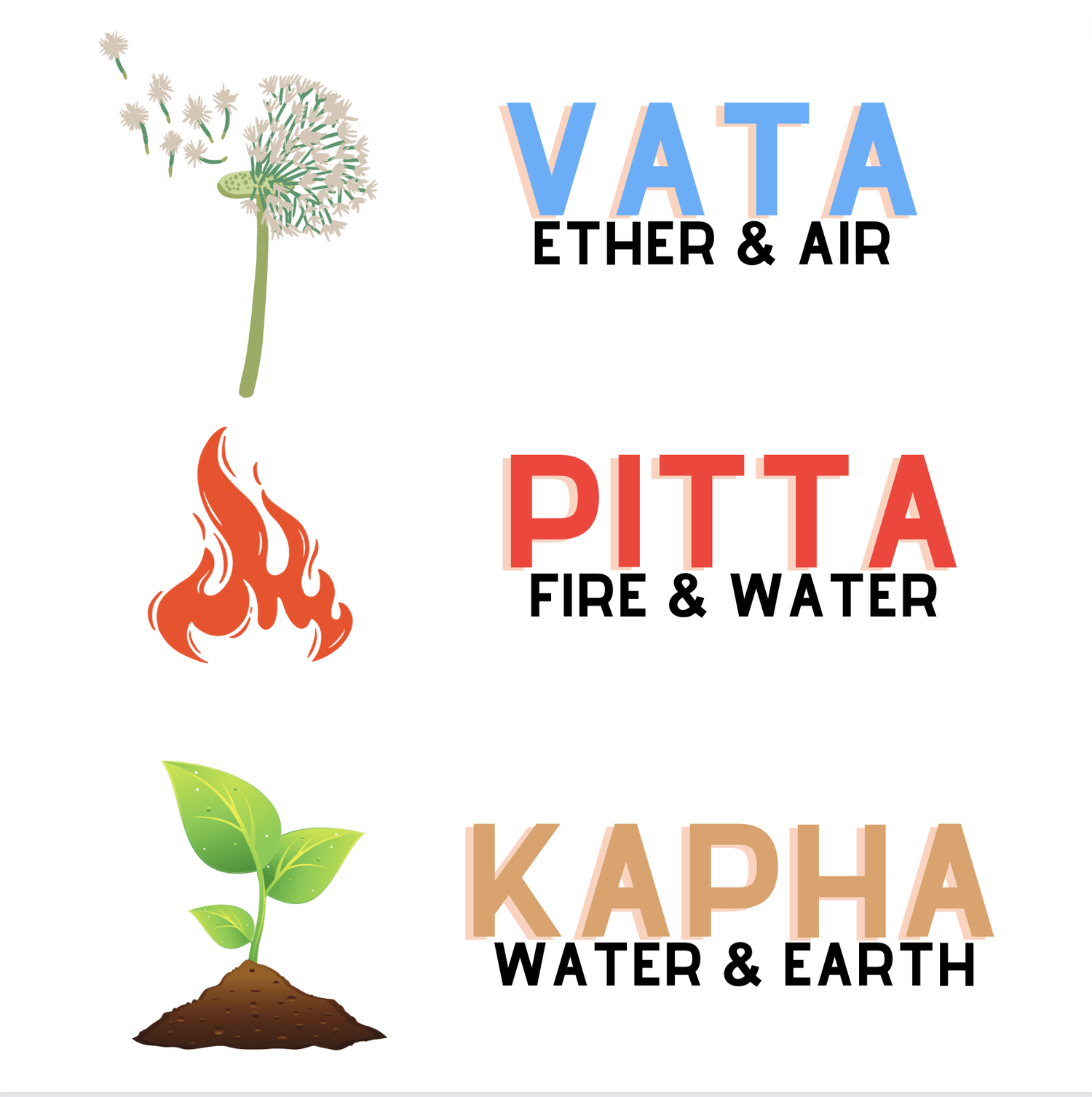
According to Ayurveda, the five elements of nature — space, air, fire, water and earth — are present within every human being. They are categorised as three components, or doshas, known as Vata, Pitta and Kapha. The doshas relate to specific functions of the body, and a balance between them is what Ayurveda understands as optimal health.

Most people are a combination of two predominant doshas, and your constitution is determined at conception. It also shapes physical build: Vata people tend to be thin with brittle bones, Pitta people athletic with muscular tone, and Kapha people larger in bone structure, tending to keep weight on. Whatever your dosha, harmony and balance are always available through Ayurvedic medical philosophy.

Take the two-minute dosha quiz
Diagram of the three doshas and the natural elements — air and space, fire and water, water and earth

Air + Space

Vata

Movement, breath, creativity

Muscle and joint movement, breathing and heartbeat, and the nervous system.

Emotions
Anxiety, fear, pain.
Build
Tends to a thin frame and lighter bones.
Balance with
Warm, oily, grounding food, Routine and regular meals
Read your Vata

Fire + Water

Pitta

Transformation, digestion, focus

Digestion, metabolism, intelligence and skin colour.

Emotions
Anger, hate, jealousy.
Build
Tends to an athletic body with muscular tone.
Balance with
Cooling, sweet, astringent food, Time away from screens and deadlines
Read your Pitta

Earth + Water

Kapha

Structure, immunity, calm

The physical structure of the body and the immune system.

Emotions
Calmness, forgiveness, love — and greed.
Build
Larger in bone structure, tends to keep weight on.
Balance with
Light, warm, spiced food, Movement every morning
Read your Kapha

How it works

How Ayurvedic medicine works.

Ayurvedic medicine uses lifestyle change — diet, exercise, stress management (yoga, pranayama and meditation) and targeted herbs — to achieve optimal balance.

Targeted treatments of panchakarma are a major component of detoxification. Panchakarma, literally “the five actions”, is a detoxification programme for mind, body and emotions. It uses five major channels to eliminate toxic substances from the body. This toxic substance is known as ama, which builds up over time and settles deep into the tissue layers of the blood and body.

Once ama accumulates, a host of disease builds up — and without removing this toxic sludge, the patient rarely improves. This is why Ayurveda holds that removing ama and resetting the gut microflora, metabolism and digestion is the primary focus of health and wellbeing.

Secondly, herbal therapy helps regulate the body systems and balance the doshas as necessary. Thirdly, lifestyle changes are adhered to: an implementation of yoga, diet and stress management. This daily routine is known as dinacharya, and there is a night-time routine as well.

The person needs to address triggers and toxins, and eliminate them from the deep tissues of the body, before embarking on a herbal plan. This can have profound effects on body and mind — and toxic substances can also take the form of toxic relationships and thoughts, not just food.


Potli therapy, a warm herbal pouch treatment at AyurvedaHK in Hong Kong

What it can support

  • Sinus infections and respiratory complaints
  • Skin problems such as acne
  • Digestive and metabolic disorders
  • Spinal issues and nervous system disorders
  • More serious conditions, in collaboration with Western medicine — diabetes, cancer and eye disease
  • Women's health, from cycles to menopause

01

Clear ama

Remove the toxic load from the deep tissues first — through panchakarma and the therapies that suit your constitution.

02

Balance with herbs

Herbal therapy then regulates the body systems and brings the doshas back to balance, prescribed for you rather than bought off a shelf.

03

Live the routine

Diet, yoga, pranayama, meditation and stress management become a daily routine — dinacharya — plus a night-time one.

What health means

Thriving, not merely surviving.

“Health is a soundness of body, mind and spirit. Each of these must be nurtured if the individual is to create health.”

A healthy person reflects their true nature: a thirst for knowledge, a passion for life and vitality. Health is not the absence of a diagnosis — it is a body, mind and spirit that are each being nurtured.

A body of optimal health and strength
Senses under total control
A mind well disciplined, clear and calm
An intellect as sharp as a razor
A will as strong and pliable as steel
A heart full of unconditional love and compassion
An ego as pure as crystal
A life filled with supreme peace, joy and bliss
Practising yoga outdoors at sunset as part of a daily Ayurvedic routine

The basic signs of wellbeing

  • A desire for nourishing food
  • Comfortable assimilation of the foods eaten
  • Comfortable passing of wastes
  • Lightness of body after eating
  • Favourable sensory capabilities
  • Easy and sound sleep, and easy awakening
  • A good source of energy, strength and endurance
  • A good complexion and span of life
  • A positive and cheerful spirit

If disease (dis-ease) occurs, health is achieved by getting to the cause of the problem. Ayurveda teaches individuals how to heal themselves from a deeper understanding of Self. That understanding is what allows a daily routine and a seasonal regime to prevent any dosha from getting out of balance.

The library

Everything Ayurveda, in one place.

Digestion, daily rhythm, taste, tissue, the womb, sound and sacred form. Each topic has its own page, written to be read — and to be looked up when you need it.

Foundations

The core ideas: digestion, routine, taste, tissue and diagnosis.

Women's wisdom

Womb, yoni and the practices that tend them.

Subtle body

Sound, vibration and sacred geometry.

Nature & materia medica

Herbs, animal archetypes and the natural world.

Questions

Ayurveda, answered.

Is Ayurveda a replacement for medical care?

No. Ayurveda works alongside, not instead of, your medical care. A practitioner does not diagnose disease or replace your doctor. Ayurvedic guidance is used to support the body, and more serious conditions are approached in collaboration with Western medicine.

What are the three doshas?

The five elements of nature — space, air, fire, water and earth — are grouped into three doshas. Vata is air and space and governs movement, breath and the nervous system. Pitta is fire and water and governs digestion, metabolism and focus. Kapha is earth and water and governs structure and immunity. A balance of the three is what Ayurveda understands as good health.

What is ama?

Ama is the toxic residue that builds up in the body over time and settles deep into the tissue layers. Ayurveda holds that removing ama and resetting digestion, metabolism and gut flora is the first focus of health — before herbs or a longer-term plan.

Do I need to know my constitution before I begin?

It helps, but it is not a prerequisite. The dosha quiz gives you a first reading of your constitution in two minutes. A consultation goes further, using your history, pulse and tongue to confirm what is out of balance and what to do about it.

Where to begin

Understand your constitution, then work with someone who can read it.

Ayurveda works alongside, not instead of, your medical care. I do not diagnose disease or replace your doctor. What Ayurveda can and cannot claim.

Dosha Diva

Your Ayurvedic confidante

Namaste, lovely. I'm Dosha Diva — ask me about your constitution, a consultation, the cleanse, the Ritual Club or anything on the shelves.

General guidance only. Not medical advice.

We use cookies to understand how the site is used, so we can improve it. You can accept or decline analytics — nothing is tracked before you choose.