
Subtle body · Subtle body · form
Sacred geometry & yantras
Yantras are sacred geometry's divine blueprints — visual mantras that harness energy, balance the mind and hold an intention through precise lines, shapes and symmetry.
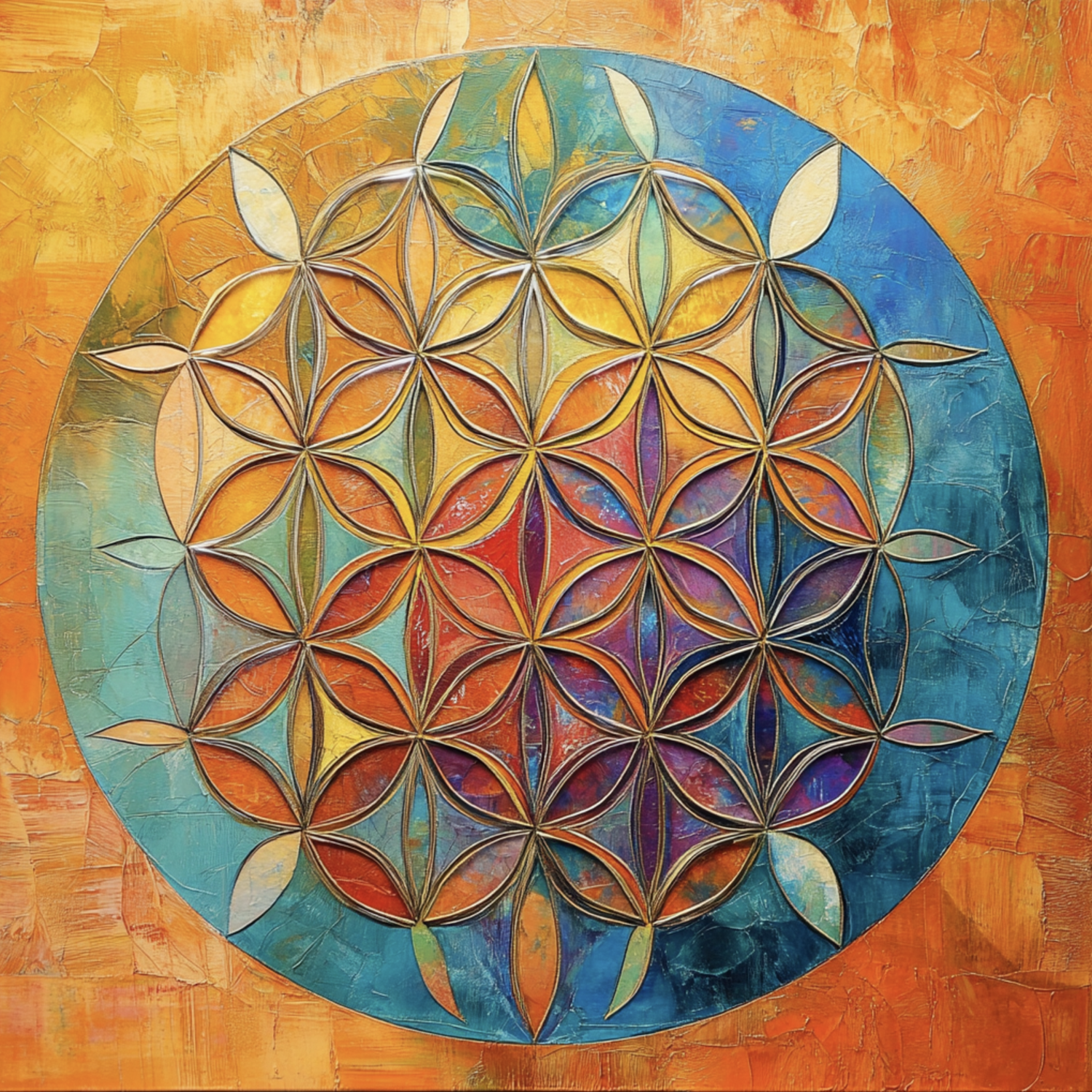
The forms are not ornaments. Each one is a construction: circles drawn from circles, triangles nested until a centre appears — the same geometry that turns up in cells, crystals, shells and orbits.
Below are the thirteen forms that recur through the tradition, each with its construction, where it appears, and the natural pattern it echoes.
How to read a diagram
Every form below is described in three layers. Read them together: the drawing, the tradition it belongs to, and the pattern in the natural world that it resembles.
- Structure — how the form is constructed, in lines and circles.
- Tradition — where the form appears, and what it has meant.
- Resonance — the natural pattern it echoes, offered as analogy rather than proof.
The thirteen forms
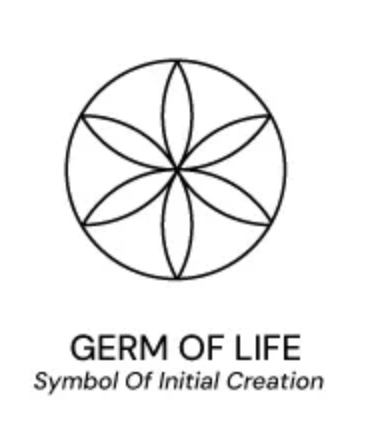
01 · First spark
Germ of Life
The symbol of initial creation
- Structure
- Seven circles — six petals around a central core — the simplest complete flower.
- Tradition
- The first stage of sacred geometry's unfolding: the point at which unity begins to take shape. Precursor to the Seed and the Flower.
- Resonance
- The pattern of the first cell dividing: one becomes two, two becomes six, and the form holds.
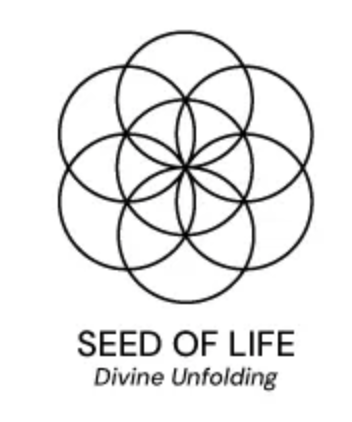
02 · Divine unfolding
Seed of Life
Seven circles, seven stages
- Structure
- Seven perfectly overlapping circles: one central, six surrounding, in six-fold symmetry.
- Tradition
- The seven days of creation in Genesis; in Egypt, the mound of Atum rising out of Nun. It maps the first seven stages of manifestation.
- Resonance
- The hexagonal packing seen in graphene and in cell tissue — the template from which the Flower of Life is drawn.
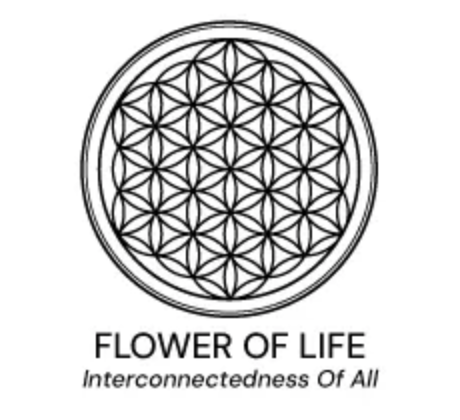
03 · Interconnectedness
Flower of Life
Nineteen circles, endless repetition
- Structure
- Nineteen overlapping circles in hexagonal symmetry; extended, the grid repeats without end.
- Tradition
- Carved at the Osireion at Abydos; the “Genesis pattern” of Kabbalah, and a motif across temple art from China to Turkey.
- Resonance
- A study in how equal circles pack and repeat — the grid from which the Fruit of Life and Metatron's Cube are extracted.
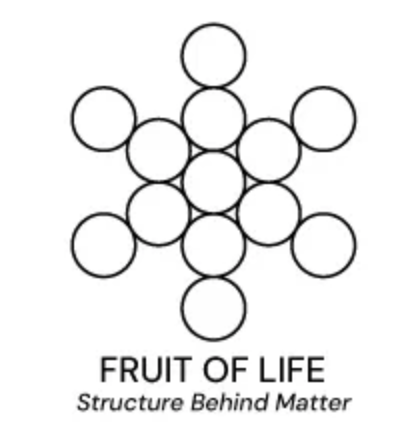
04 · Thirteen circles
Fruit of Life
The framework of creation
- Structure
- Thirteen circles taken from the Flower of Life's intersections, spaced so that no two overlap.
- Tradition
- Said to hold the blueprint of the five Platonic solids — earth, air, fire, water and aether — linking the microcosm to the macrocosm.
- Resonance
- A map of perfect containment: thirteen equal spheres that touch without merging.
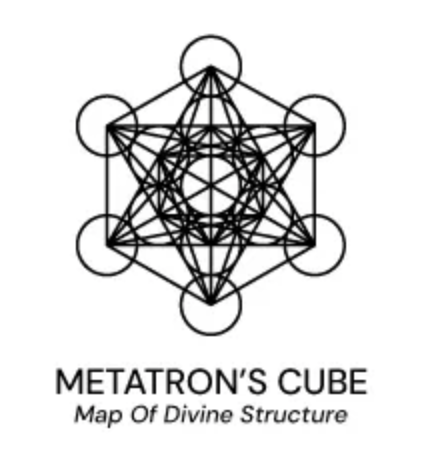
05 · Map of divine structure
Metatron's Cube
Every line between thirteen points
- Structure
- The thirteen circles of the Fruit of Life joined by every connecting line — 78 lines — from which the five Platonic solids emerge.
- Tradition
- Named for the archangel Metatron, keeper of divine knowledge; in alchemy, a key to the philosopher's stone.
- Resonance
- One diagram that renders all five regular solids: the shapes underlying crystal and molecular structure.
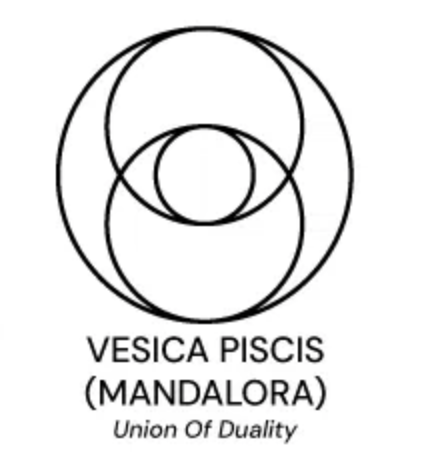
06 · Union of duality
Vesica Piscis
The first form born of two
- Structure
- Two circles of equal radius, each passing through the other's centre, overlap into an almond — the √3 proportion.
- Tradition
- The ichthys of early Christianity, the mandorla of sacred art, the yoni of tantric symbolism: unity meeting itself.
- Resonance
- The geometry behind Gothic arches and cathedral windows — two systems sharing one field.
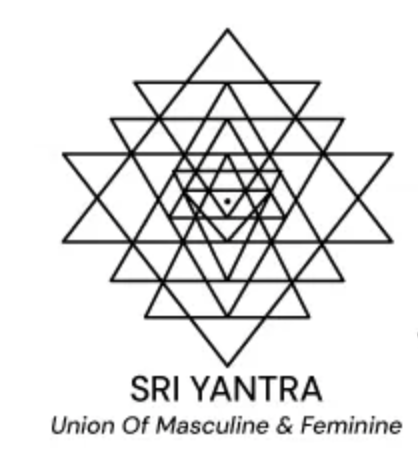
07 · Union of opposites
Sri Yantra
Shiva and Shakti, nine triangles
- Structure
- Nine interlocking triangles — four upward, five downward — forming 43 smaller triangles inside eight lotus petals and a square enclosure, with a bindu at the centre.
- Tradition
- The most venerated yantra of the tantric tradition. “The yantra is the body of the deity”: the cosmos manifesting from a single point.
- Resonance
- Its nested triangles approach the golden ratio; the whole diagram is a map of coherence — many layers resolving into one centre.
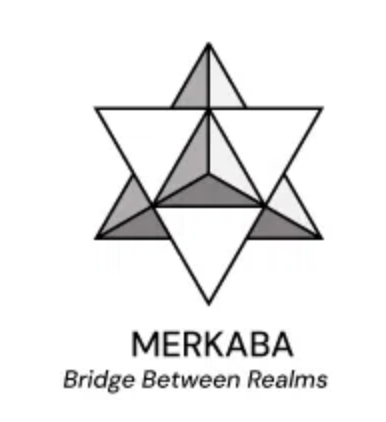
08 · Bridge between realms
Merkaba
The light body
- Structure
- Two interlocking tetrahedrons, one pointing up, one down — the star tetrahedron.
- Tradition
- The light body of ascension traditions, and Ezekiel's wheels within wheels: the chariot that bridges realms.
- Resonance
- A three-dimensional star built from the simplest solid — four points, four faces, every direction accounted for.
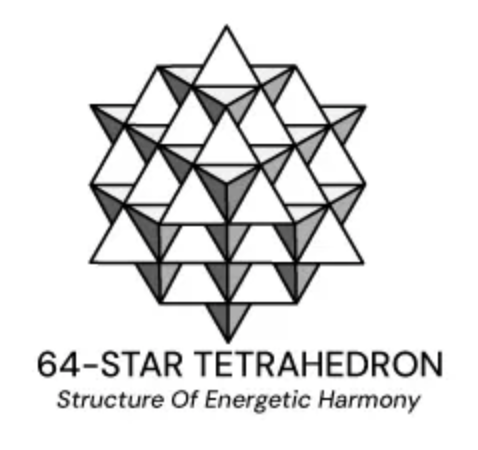
09 · Structure of harmony
64 Star Tetrahedron
The fractal grid
- Structure
- Sixty-four smaller tetrahedrons nested inside a star tetrahedron, repeating the same shape at every scale.
- Tradition
- The 64 hexagrams of the I Ching, the 64 kalas of Shiva, and the 64 codons of DNA.
- Resonance
- The geometry of the vacuum in Nassim Haramein's model; and the binary cube, from 000 to 111.
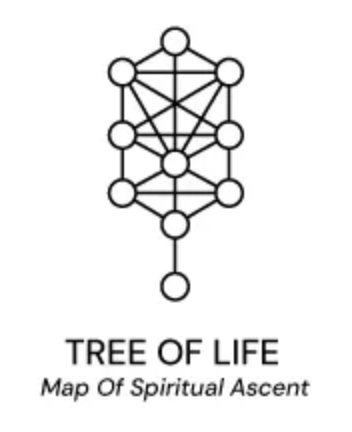
10 · Map of spiritual ascent
Tree of Life
Ten spheres, twenty-two paths
- Structure
- Ten spheres — the Sephirot — joined by 22 paths: 32 paths of wisdom in all.
- Tradition
- Kabbalah's map of creation, from the infinite to the material world; echoed in the 32 marks of the Buddha.
- Resonance
- A diagram of emanation: how a single source steps down into density, one sphere and one path at a time.
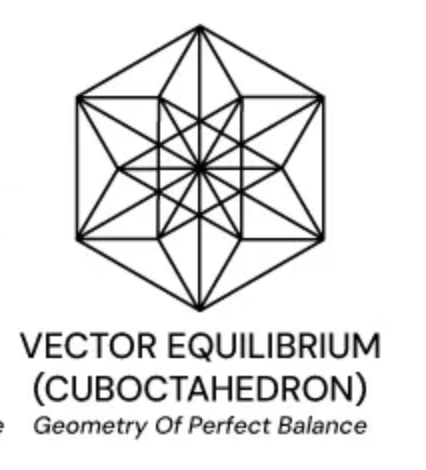
11 · Geometry of perfect balance
Vector Equilibrium
The cuboctahedron
- Structure
- Twelve vertices, 24 equal edges: every vector the same length and the same angle.
- Tradition
- Buckminster Fuller's “zero-point of energy”, and the Vedic akasha — space before vibration.
- Resonance
- A state of perfect balance: every force met by an equal and opposite force, the still point at the centre of the field.
12 · Growth in proportion
Golden Spiral
φ, the ratio of becoming
- Structure
- A logarithmic spiral growing by the golden ratio, φ ≈ 1.618, with every quarter turn.
- Tradition
- The proportion used in the Parthenon and the Great Pyramid; read into shells, storms, ferns and spiral galaxies.
- Resonance
- Growth that neither accelerates nor stalls: each new turn the same shape, one size larger.
13 · Flow and return
Torus
The self-sustaining field
- Structure
- The donut-shaped field: energy flows out through the centre, around the outside, and back in.
- Tradition
- The Taoist uncarved block, the medicine wheel's cycle, the halo, the ouroboros.
- Resonance
- The shape of the heart's electromagnetic field and of the plasma belts around the earth — a loop that feeds itself.
A note on the science
Sacred geometry is a language of proportion, and proportion is real: the golden ratio appears in phyllotaxis, the hexagonal lattice appears in graphene, and the Platonic solids describe crystal habit. That is where the diagrams and modern physics genuinely touch.
The larger claims — that these forms encode quantum states, alter DNA, or bridge dimensions — are tradition and interpretation, not established science. They are worth holding as poetry: they give the eye somewhere to rest and the mind a way to think about order. They do not replace diagnosis or treatment.
How to work with a yantra
It is a concentration practice as much as a symbol. Nothing needs to happen: the point is the returning of attention, again and again, to a single still centre.
- Choose one form — the one you keep returning to is usually the right one.
- Keep it where you will see it daily: a desk, an altar, the back of a door.
- Gaze softly at the centre for three to five minutes, letting the lines blur.
- Close the eyes and hold the afterimage as long as it lasts, then let it go.
- Draw it by hand. Copying the construction teaches the geometry in a way looking never does.
Where to begin
Seed of Life
To steady yourself
Seven circles to follow with the eye — small, complete, and easy to hold in mind. A good first form for a daily sit.
Sri Yantra
To think about balance
The most complex of the yantras. Work with it when you want a diagram that refuses to resolve too quickly.
Golden Spiral
To think about proportion
Draw it from squares. It is the most forgiving construction here, and the one that shows up most often in the natural world.
Solfeggio frequencies
To work with sound
Geometry made audible: the same interest in rhythm, ratio and resonance, approached through the ear.