
Rituals · 7 min read
An Ayurvedic Morning Routine for Busy People (That Survives a 7am Commute)
By Lakshmi Harilela · 21 November 2026
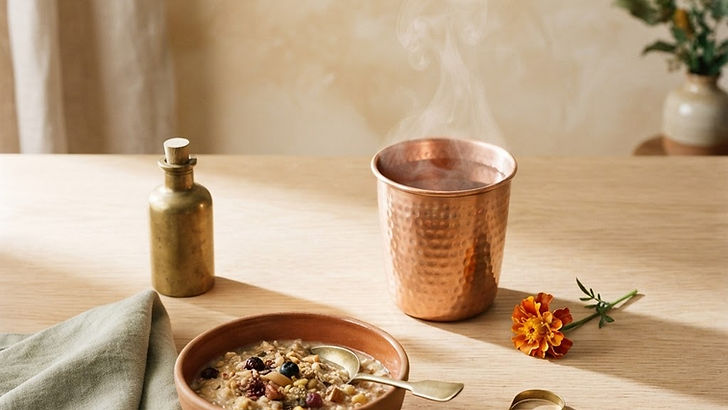
The classical Ayurvedic morning routine assumes you have an hour and a quiet house. You probably have twenty minutes and a train to catch. Here is the version that fits, in three tiers you can pick from on any given day.
The classical Ayurvedic morning routine is beautiful and, for most working people, unusable as written. It assumes an unhurried hour, a quiet house and no 7am train.
So here is the honest translation. Not a watered-down ritual, but the parts that carry most of the benefit, arranged into three tiers you can choose between depending on the morning you actually woke up to.
First, the logic
Ayurveda treats the morning as the hinge of the day. The body has been lying still and cooling for hours, digestion has slowed, and the nervous system is somewhere between asleep and alert. The morning routine is not about productivity. It is about transitioning deliberately instead of being dragged into the day by an alarm.
Everything below serves that one idea: warm the body, clear the senses, settle the mind, then move.
The five-minute version
For the mornings when you are already late.
- Warm water, before anything else. Not iced, not a smoothie. A glass of warm water, ideally before you look at your phone. It is the single easiest change on this list.
- Scrape your tongue. A copper tongue cleaner takes twenty seconds and tells you a lot about how you slept. Most people notice their mouth feels different by day three.
- Three slow breaths at the door. Before you leave, not after you arrive. Three breaths, longer on the out-breath. It is not meditation. It is a pause.
That is it. Five minutes, including finding your shoes.
The fifteen-minute version
For a normal weekday.
- Warm water, tongue scraping, and a splash of warm water on the face rather than an ice-cold one.
- A warm oil massage, brief. A small amount of sesame or Dhanvantaram oil warmed between the palms, long strokes on the arms and legs, circles on the joints, then shower as usual. Three to five minutes. This is the practice people report missing most once they stop.
- A cooked breakfast. Porridge, congee, eggs, last night's vegetables reheated with a little ghee. Cold cereal in a Hong Kong winter is a small act of self-sabotage.
- Ten minutes of daylight, outdoors if possible. Walk to the station the longer way.
The thirty-minute version
For a slower morning, a weekend, or a day you are working from home.
Add to the fifteen-minute version: five minutes of gentle movement, a few rounds of slow sun salutations or simple joint rotations; five minutes of sitting quietly without a screen; and a proper sit-down breakfast rather than one eaten standing at the counter.
What to skip, even though the internet loves it
- A five a.m. alarm. In Ayurveda the ideal wake time follows sunrise, and in Hong Kong that shifts through the year. Rising with the light is the point. If you are going to bed at midnight, a five a.m. alarm is not discipline, it is sleep debt.
- Cold showers as a morning requirement. They suit some constitutions. If your hands are always cold and your sleep is light, warm is the better default.
- A twenty-step routine. Anything that takes longer than the time you actually have will not survive a Tuesday.
- Skipping breakfast to compensate for yesterday. Eat warm, eat simply, move on.
How to make it stick
The failure mode is not laziness, it is planning for your best morning rather than your average one. So pick the tier that matches your worst normal day, and let the better mornings be a bonus.
One habit at a time. Warm water first, for a week. Then the tongue scraper. Then the oil. By the end of a month you have a routine that has survived real life, which is the only kind that counts.
If you want the whole framework
The classical routine, dinacharya, is more detailed than this: oral care, nasal oil, eye care, exercise, and the seasonal variations that go with each. Our Ayurveda Daily Routines guide covers it in full, and the journal has the seasonal versions as the year turns.
If you would like the routine built around your own constitution rather than the average reader's, a consultation is the place to do that. And if you would rather have one practice, one recipe and one live circle arriving each month, that is what the Ritual Club is for.
Start with the water. Everything else follows.
Know someone who needs this? Send it on.
WhatsAppThe journal, by letter
Slow notes, once a month.
Seasonal eating, new recipes and the rituals worth keeping — written by Lakshmi and sent from her own inbox.
Work with Lakshmi
If this raised a question about your own health, a consultation is the place to take it.
Ayurveda works alongside, not instead of, your medical care. I do not diagnose disease or replace your doctor.


