
Food & remedies · 16 min read
Castor Oil in Ayurveda: Eranda Taila for Constipation, Pain and Vata
By Lakshmi Harilela · 27 November 2026
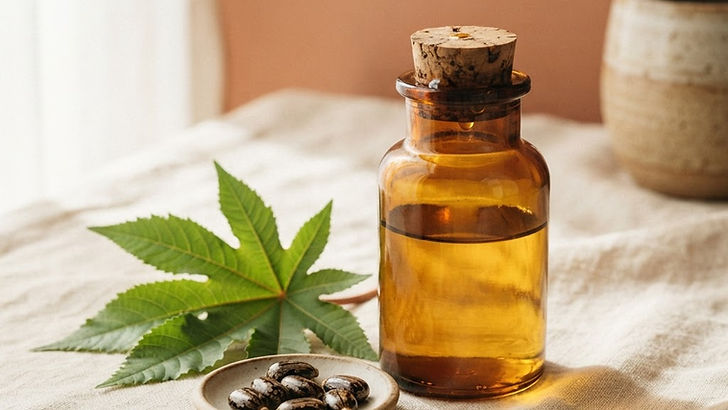
Castor oil is the one oil Ayurveda treats as medicine first and cosmetic second. What eranda taila actually does, how to take it internally, how to use it on the body, and who should avoid it entirely.
Castor oil has an unusual place in Ayurveda. It is not a carrier oil with a story attached, and it is not a supplement. It is a medicine that happens to be an oil, used in the clinic for two things above all: a bowel that has stopped moving, and pain that will not settle.
The internet has rediscovered it, mostly on the belly button. None of it is new. Eranda has been in medicinal use for thousands of years, and the classical texts are more precise about it than the trend cycle is, and more careful: castor oil is powerful, the dose matters enormously, and the list of people who should not use it is not short.
Why one oil carries so much weight
Ayurveda classifies every substance by taste, quality, potency and post-digestive effect. Castor oil's profile is lopsided, and that is why it works.
- Rasa (taste): madhura (sweet), katu (pungent), kashaya (astringent).
- Guna (qualities): guru (heavy), snigdha (unctuous), sara (flowing), tikshna (sharp), sukshma (subtle, able to enter deep tissue).
- Virya (potency): ushna, heating, when taken internally; cooling on the skin.
- Vipaka (post-digestive effect): madhura (sweet).
- Effect on the doshas: pacifies vata and kapha, increases pitta internally.
Classical texts call eranda vata-kapha shamaka and pitta-vardhaka, hot and sharp, which is why a pitta constitution should not take it freely. Modern teachers sometimes call it tridoshic, because on the skin it is cooling rather than heating. Both are true: route and dose change the medicine, and that is why one oil serves a dry vata colon, an inflamed pitta eye and a congested kapha abdomen.
Read the rest as instructions. Heavy and oily counters dryness. Hot counters cold. Flowing and sharp move what has stagnated, and subtle reaches deeper than its thickness suggests. This is the anti-stagnation oil.
Eranda, the plant and its names
In Sanskrit the plant is eranda, the oil eranda taila, also called gandharvahasta, the hand of the celestial musician, for its palmate leaf. Charaka places it among the substances of choice for vata, Sushruta uses it for the abdomen and the joints, and Bhavaprakasha gives it a chapter. Ayurveda distinguishes the small shrub, laghu eranda, from the large tree form, brihat eranda; the small variety is considered stronger.
The seed, the ricin, and the people who pick it
Castor seeds contain ricin, by the USDA's account around seven times more poisonous than cobra venom, and the shiny beetle-shaped seeds carry allergens strong enough to cause hives, asthma and, rarely, anaphylaxis in workers handling castor meal. Mechanical harvesting has reduced that exposure.
None of this is a reason to fear a bottle of oil. Ricin stays in the seed and the pressed meal, not in properly processed oil, and cold-pressed medicinal castor has had it removed. It is a reason to be sensible: never eat the seeds, never let children play with them, never use home-pressed oil internally, and buy from a supplier who can say where the beans came from.
It is also why food grade should be read carefully. The FDA approves castor oil as an over-the-counter laxative, and only as a laxative. No topical use is approved, and food grade is marketing, not a guarantee.
Classically the oil is boiled, often with milk or water, to temper its sharpness, a process called murchana. Cold-pressed oil today is usually unboiled, fine externally and in small doses, but a therapeutic purge belongs with a practitioner who knows the preparation. Buy cold-pressed, hexane-free, organic where possible, in dark glass. It should smell faintly nutty, never sharp. Rancid castor oil is a skin irritant.
How it works, in two languages
In Ayurveda, castor oil is anulomana: it moves vata downward in its natural direction rather than suppressing it. At a larger dose it becomes virechana, a purgative that clears the bowel and, classically, the channels above it. It is srotoshodhana, channel-clearing, and it kindles agni without being dry. It is also a carrier: cooked with herbs or taken as an anupana, it guides their qualities deeper into tissue, which is why classical pharmacy pairs it with haritaki and ginger.
In modern terms, roughly ninety per cent of castor oil is ricinoleic acid. In the small intestine it triggers secretion and motility through prostaglandin-mediated pathways, and three to six hours later the result is a soft or liquid stool. The same mechanism explains the cramping. On the skin it is a heavy occlusive oil that holds moisture into dry, cracked skin.
Internal use: the dose decides the medicine
This is the most important thing to understand. Castor oil is three different medicines depending on how much you take.
- 3 to 5 ml, half to one teaspoon: a gentle anulomana. Softens stool, relieves gas and bloating, restores a sluggish bowel without a purge.
- 10 to 15 ml, two to three teaspoons: a proper laxative effect, usually four to eight loose motions over a few hours. The classical mridu virechana range.
- 20 ml and above: a therapeutic purge, under supervision, with the preparation, timing and follow-up classical virechana requires.
Response varies more between people than any table suggests. A practitioner with decades of residential panchakarma experience stopped using castor oil in at-home cleanses for exactly this reason: two teaspoons was the perfect purge for one person and far too much for the next. Start at the smallest dose and find your own threshold before you plan a morning around it.
How to take it
Warm it slightly; cold castor oil is harder to swallow and harder on the stomach. The two classical vehicles are warm milk and warm ginger water. With an equal quantity of warm milk it is gentler and more nourishing, the version used for vata constitutions and joint complaints. With warm water and grated ginger it is lighter and more clearing, better for kapha and a gassy bowel.
Take it at bedtime, two hours after dinner, so the effect arrives early the next morning rather than mid-workday. Sip rather than swallowing it in one go, and follow with warm water.
A traditional way it is taken
In India one classical instruction for joint pain is a teaspoon worked into a chapati and eaten with the main meal, daily, for months. It is a slow, food-based way of taking it, and it says how Ayurveda regards this oil: not an emergency purge but a steady influence on vata. I would not begin there. Begin small, and let a practitioner build the longer protocol.
What to expect
Nothing happens for a few hours, which makes people take more. Do not. Three to six hours later come rumblings, urgency, then two to six loose stools. Drink warm water, eat lightly, and keep the next morning free the first time. Khichari is the right meal afterwards.
How often
Not daily, not indefinitely. Three to seven nights for a sluggish bowel, then reassess; or once a week to once a fortnight as a seasonal reset. Daily use over months teaches the bowel to depend on it.
Constipation: which kind responds, and which does not
Ayurveda does not treat constipation as one condition, and castor oil is not the answer to all of them.
- Vata-type: dry, hard, pellet-like stools, gas, bloating, incomplete evacuation, worse with travel, stress, cold and irregular meals. Castor oil's home ground.
- Pitta-type: hard stools with heat, acidity, headache, irritability, sometimes bleeding piles. Castor's heat can aggravate this. Use a small dose with milk, or choose triphala.
- Kapha-type: infrequent but not especially dry stools, heaviness, a slow bowel. Warm water, honey, triphala and movement do more.
For the vata pattern: half to one teaspoon of warm castor oil in half a cup of warm milk, thirty minutes before bed, for three nights, with warm water in the morning, warm cooked food, no cold drinks, and a walk. If nothing changes, or you need it nightly, the bowel is not the problem. The pattern behind it is, and that is what a consultation looks at.
One classical formula worth knowing is Gandharva haritaki, haritaki cooked with castor oil. It pairs castor's downward movement with haritaki's gentler toning of the bowel, and for many people it is a better longer-term companion than nightly oil.
Pain, stiffness and the joints
Classical Ayurveda uses castor oil internally for amavata, the rheumatoid pattern, gridhrasi or sciatica, kati shula, low back pain, janu shula, knee pain, and general sandhi vata, joint vata. The reasoning is not that castor is a painkiller. It is that vata lives in the colon, and a dry, blocked colon pushes vata upward and outward into the joints, where it shows up as stiffness, cracking, dryness and shifting pain.
So the treatment starts at the gut. In amavata the classical approach is castor oil with ginger and warm water, or with milk, regularly over weeks alongside a diet that removes cold, heavy and fermented foods. It is slow work and it is not glamorous.
A practical version for a vata pattern of stiffness with constipation: five to ten millilitres of warm castor oil in ginger water or milk at night, three nights a week for four to six weeks, with warm meals, no iced drinks and gentle daily movement. Then reassess honestly.
The evidence, honestly
The internal use is well established as a stimulant laxative; much of the topical reputation is traditional rather than proven. A review of nine studies on topical castor oil found signals worth taking seriously, and gaps worth admitting.
- Neuropathic pain: topical castor oil has shown benefit in post-herpetic neuralgia, diabetic neuropathy and other neuropathic pain, and in one comparison it performed like capsaicin without the skin irritation.
- Tendonitis: in a study of sixty patients having shockwave therapy, castor oil was the coupling agent, compared with ultrasound gel and petroleum jelly. The castor group did at least as well.
- Eyes: castor oil preparations have been studied for blepharitis, dry eye and meibomian gland dysfunction, where its lipids support the tear film.
- Wound healing, arthritis, cramps, labour induction: long traditional use, thin modern evidence.
The conclusion is not that castor oil is useless. It is a genuine laxative, a good barrier oil for dry skin, and a plausible comfort measure for certain pain, and everything beyond that should be called traditional rather than proven.
External use: the castor oil pack
In Ayurveda the classical version is a poultice, upnaham, often castor leaves and oil for swelling and pain. The flannel pack as most people know it was popularised in the early twentieth century by Edgar Cayce, whose protocols were widely adopted in naturopathic practice. He recommended a castor-soaked flannel pad over any area of pain, over the liver, over the lower abdomen for elimination and over the stomach for indigestion, applied in the evening after rest, with or without heat, for up to an hour and a half.
How to do it:
- Warm two to four tablespoons of castor oil in a bowl set in hot water. Never microwave it.
- Fold a cotton or flannel cloth into three or four layers, saturate it, wring out the excess.
- Place it over the area: lower abdomen for cramps and a sluggish bowel, knee or lower back for stiffness, or the right upper abdomen for the naturopathic liver protocol.
- Cover with a dry towel and a hot water bottle, and lie down for forty-five minutes to an hour and a half.
- Remove, wipe with warm water, and rest ten minutes before getting up.
Three to five evenings a week for two to three weeks is a reasonable trial, starting at thirty or forty minutes if you are new. Avoid it over the abdomen in pregnancy, over broken or infected skin, and during a fever.
The liver pack deserves one honest line. It is not classical Ayurveda, and the claims made for it, from dissolving cysts to clearing toxins, are not supported. It is a warm compress. It may help you feel better. It will not do the work of medical care.
The navel: a small practice with a long history
The navel is the nabhi, the meeting point of prana vayu, which moves inward and upward, and apana vayu, which moves downward and out. When apana is blocked, the result is the picture castor oil is used for: constipation, gas, lower abdominal heaviness, painful periods.
Warm a few drops, apply to the navel and around it, then massage the abdomen clockwise for a minute or two, following the colon. Rest ten or fifteen minutes, or sit in morning sunlight. It is used for a sluggish bowel, bloating and lower abdominal heaviness, and it is a gentler entry point than taking the oil by mouth. It will not do anything dramatic, and it is not a treatment for a diagnosed condition.
Cysts, corns and calluses
Traditional sources list castor packs for cysts, growths, warts, corns and calluses, and this is the claim that needs the firmest caveat. For corns, calluses and hard skin on the feet, a warm pack or a nightly application under a sock is harmless and often softening. For warts the evidence is thin and the treatments that work are medical.
For any lump or cyst inside the body, do not self-treat. A pack over an undiagnosed mass delays the scan that would have told you what it is. Some cysts are harmless and some are not, and no oil can tell the difference.
Eyes: the one-drop practice
The eye is a seat of pitta, governed by alochaka pitta, and burning, gritty, tired eyes are read as heat there. Some classical teachers, including Dr. Vasant Lad, recommend one drop of pure castor oil in each eye at bedtime for this pattern, and many people find it soothes dry, burning eyes overnight.
Be precise about what you use: pure, properly filtered oil intended for the eye, not a cosmetic oil, and not from a bottle left open in a warm cupboard. Not with contact lenses in, an eye infection, an injury, recent surgery or a known allergy. Stop at the first sign of stinging that does not settle.
Netra tarpana, the pooling of medicated oil around the eyes, is a different and more involved practitioner treatment. A drop of castor oil is not that.
Ears, scalp and skin
Karna purana, warm oil in the ear, is classical for earache, a blocked sensation and ringing. A few drops warmed to body temperature is the household version. Never with discharge, a perforated eardrum or after ear surgery.
Warm castor oil on the scalp an hour before washing suits a dry, flaky, tight scalp and hair that breaks easily. It is heavy, so cut it with coconut or sesame unless the scalp is very dry. For vata types the classical blend is sesame with a little castor: sesame warms and grounds, castor penetrates and softens. It conditions and reduces breakage; it does not regrow hair.
On skin it is at its best on cracked heels, fissures, dry elbows, rough patches and healing wounds, where its thickness forms a real barrier. Apply to slightly damp skin after bathing, cover with socks or a dressing. Not on weeping eczema or infected wounds, where trapping moisture and bacteria makes things worse.
Women's health
Castor oil is used for kashtartava, painful menstruation, and for scanty or absent periods of the vata type, usually as a warm pack over the lower abdomen before and during the period, with small internal doses under guidance.
The contraindication is absolute: do not take castor oil internally during pregnancy. It stimulates the uterus, and using it to bring on labour is dangerous. That use appears in old textbooks and folk practice and belongs in neither. Avoid the abdominal pack in pregnancy, avoid internal use during heavy bleeding, and ask before using it while breastfeeding.
What it genuinely helps, and what it does not
It reliably helps short-term constipation of the vata type, and it is one of the better oils for dry skin, cracked heels and a dry scalp. It gives real symptomatic comfort in stiffness and period cramps when used warm and consistently.
It does not cure arthritis, reverse joint damage, regrow hair, dissolve cysts, detox the liver or treat cancer. It is not a weight loss remedy, though a purge will make you lighter for a day. It is not a substitute for a diagnosis when constipation is new, painful, or comes with bleeding, weight loss or anaemia. The evidence page sets out how we read research like this.
Safety and interactions
Do not use castor oil internally if you are pregnant or trying to conceive, breastfeeding without advice, or under twelve. Avoid it with an acute abdomen, suspected obstruction, impacted stool, severe diarrhoea, active inflammatory bowel disease, unexplained rectal bleeding, or within two weeks of surgery. Strong pitta constitutions, acidity, bleeding piles and heavy periods call for small doses with milk, and preferably guidance.
As a laxative it can reduce absorption of medicines taken at the same time, including the contraceptive pill, so leave two hours between castor oil and any medication. Loose stools can affect INR on warfarin and blood sugar on diabetes medication, and repeated purging disturbs electrolytes. Patch test before using it on a large area. Stop and seek advice with severe cramps, vomiting, blood in the stool, no stool at all with worsening pain, a rash, or dizziness.
A simple starting protocol
For a dry, sluggish, gassy bowel:
- For three nights, take one teaspoon of warm castor oil in half a cup of warm milk, thirty minutes before bed.
- Warm water in the morning, a warm cooked breakfast, no iced drinks for the week.
- If nothing shifts, or you need it nightly, book a consultation. Repeating a laxative is not treating the cause.
For stiffness with a vata pattern: three nights a week for four to six weeks, plus a warm pack on the joint three evenings a week.
When to see a practitioner
Constitution matters more with castor oil than with almost any other household remedy, because it is hot, sharp and strong. With acidity, piles, a pitta constitution, a hormonal condition, or simple uncertainty about your pattern, a short consultation saves months of guessing. You can book a consultation in Tsim Sha Tsui or online, take the dosha quiz, or read what happens in an Ayurvedic consultation first.
Can I take castor oil every day?
No. A few nights, or once or twice a week, is the sensible pattern. Daily use over months makes the bowel dependent.
Is it safe in pregnancy?
Not internally at any dose, and not to induce labour. Avoid the abdominal pack, and ask before using it on skin elsewhere.
What does it do on the belly button?
Warm oil on the nabhi, with slow clockwise massage, is a traditional support for a sluggish bowel, bloating and lower abdominal heaviness. Gentle, and not a treatment for a diagnosed condition.
Can I put it in my eyes?
Some teachers recommend one drop in each eye at bedtime for burning, dry eyes, and castor preparations have been studied for dry eye and blepharitis. Pure eye-intended oil only, never with infection, injury, lenses or recent surgery.
Does it interact with my medication?
It can, mainly by speeding transit and reducing absorption. Leave two hours, and check with your doctor if you take warfarin, diabetes medication or the pill.
Know someone who needs this? Send it on.
WhatsAppThe journal, by letter
Slow notes, once a month.
Seasonal eating, new recipes and the rituals worth keeping — written by Lakshmi and sent from her own inbox.
Work with Lakshmi
If this raised a question about your own health, a consultation is the place to take it.
Ayurveda works alongside, not instead of, your medical care. I do not diagnose disease or replace your doctor.


