Rituals · 9 min read
Sauna, Steam and the Crown: Why Ayurveda Covers the Head
By Lakshmi Harilela · 19 November 2026
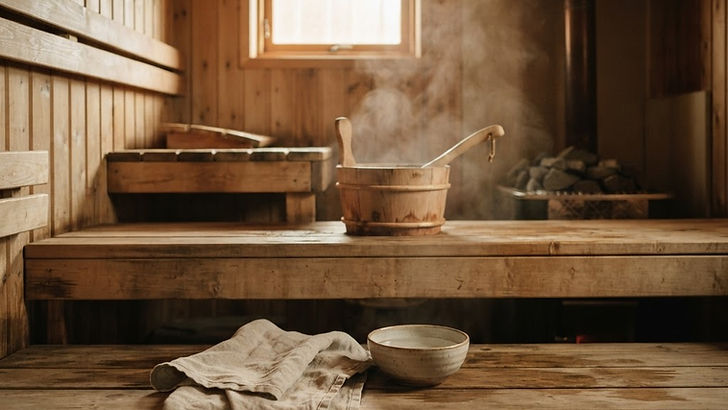
A traditional sauna is one of the oldest forms of medicine we still practise for pleasure. What the heat really does for the body, and why Ayurveda has always kept the head cool and covered.
There is a particular kind of quiet that only exists in a wooden room full of steam. No phone, no conversation worth having, nothing to do but sit and let your body do what it already knows how to do. A traditional sauna is one of the oldest forms of medicine we still practise purely for pleasure.
But it is medicine, and like any medicine it has a way of being done well and a way of being done badly. The single most useful thing I can tell you about sitting in heat is the thing almost everyone forgets: protect your head.
What the heat actually does
When you step into a sauna, your body meets a wall of heat and responds immediately. Blood vessels near the skin open, heart rate rises by roughly ten to twenty beats a minute, and the heart pumps harder, in a way that resembles moderate exercise. Sweating begins, and with it comes fluid, sodium and a little of everything your skin has been holding.
Then the deeper shifts. Muscle tension releases. The nervous system swings from sympathetic to parasympathetic, which is why a sauna feels like a long exhale. Body temperature climbs, and afterwards it falls again, often leaving people with noticeably better sleep that night. Many people describe the mood lift that follows, and there is a plausible physical reason for it: the body releases endorphins and heat shock proteins, small protective molecules that help cells cope with stress.
Long-running observational studies from Finland, where sauna is simply part of ordinary life, have associated frequent sauna use with lower cardiovascular risk. These are associations, not proof, and they do not promise anything. But the direction is consistent with what we see in clinic: regular, gentle heat, followed by rest, is good for circulation, recovery and the nervous system.

Sauna through an Ayurvedic lens
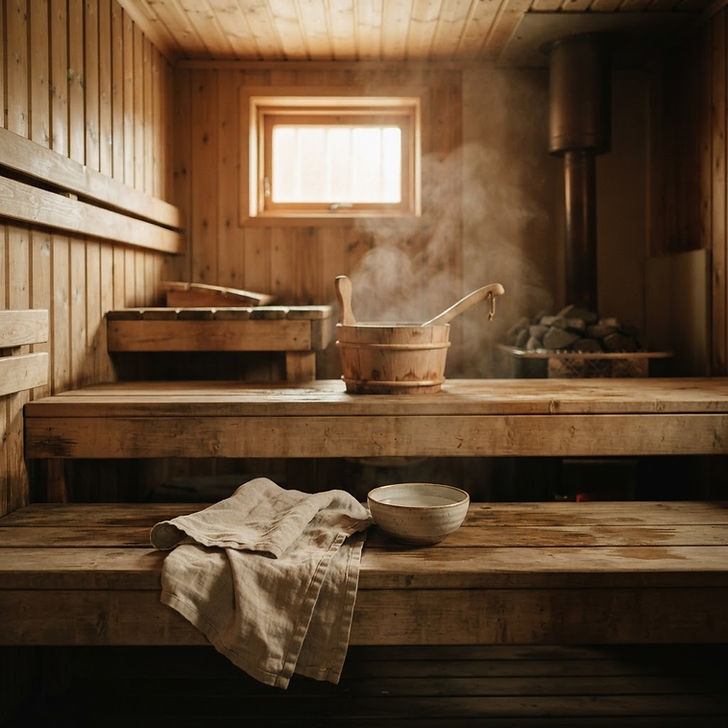
Ayurveda has a name for this: swedana, the therapy of induced sweating. It is one of the preparatory steps of panchakarma, and its purpose is precise. Heat softens what has become stuck. It liquefies ama, the residue of incomplete digestion that Ayurveda treats as the root of most chronic sluggishness. It opens the srotas, the channels through which the body moves nourishment in and waste out. Then the sweat, the breath and the gut carry that loosened material away.
This is why a sauna, well used, leaves you feeling lighter rather than merely tired. You have not just lost water. You have moved something.
Different constitutions respond differently, and the heat should be adjusted to suit. Vata types run dry and cold, so they benefit from moisture and shorter rounds, and they should not stay so long that they come out depleted. Kapha types carry heaviness and congestion, and respond best to drier heat and a longer, more stimulating sit. Pitta types already run hot, and are the ones who most often overdo it, then wonder why they feel irritable and inflamed afterwards.
Why the head is treated differently
Here is the part that Ayurveda has insisted on for thousands of years and modern sauna culture is slowly rediscovering.
The head is the seat of pitta. Specifically, sadhaka pitta governs the mind, perception and emotional digestion, and its home is the brain. The brain is the most heat-sensitive organ you own. It generates its own warmth, it sits at the top of the body where heat naturally rises, and it has a thin covering of skin and very little fat to insulate it. In a sauna, the temperature at head height is often considerably hotter than at the bench, and the skull conducts that heat inward.
So when the head overheats, you feel it in a very particular way: throbbing, flushing, dizziness, ringing in the ears, irritability, a rising feeling of panic, sometimes nausea. Anyone who has stayed in a sauna too long and come out light-headed has felt sadhaka pitta pushed past its limit. Ayurveda also treats the crown as a marma, a vital point called adhipati, associated with prana and ojas. Direct, sustained heat on that point is avoided in the same way you would avoid pressing hard on any marma.
Classical swedana instructions are explicit about this: the body is heated, the head is kept cool. In traditional practice, a cool damp cloth is laid over the head and refreshed as it warms.

The old habit of the hat
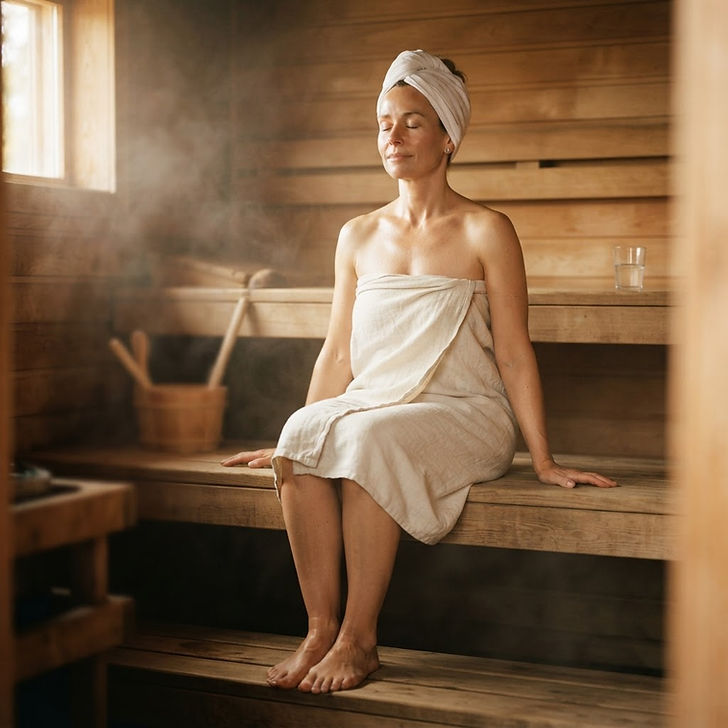
If you have ever wondered why Finnish saunas sell felt hats, or why bathers in a Russian banya wear them, this is the answer. A wool or felt cap insulates the scalp. It slows the transfer of heat to the head while the rest of the body sweats freely, and it keeps the ears comfortable. In a Turkish hammam the head is wrapped in cloth for the same reason, and in a Japanese onsen a small folded towel is rested on the crown.
Different cultures, one instinct. Cover the head, let the body do the work.
The same logic runs in reverse in cold weather, which is why we cover our heads in winter too. The scalp is thin, richly supplied with blood and poorly insulated, so it is one of the fastest places to gain heat and one of the fastest to lose it.
How to take a good sauna
- Begin with a cool rinse and wet your hair or lay a cool cloth on your head before you sit down.
- Wear a cotton or felt cap, or a folded cloth kept damp, over the crown.
- Sit for eight to fifteen minutes for the first round. Come out before you feel unwell, not after.
- Cool down slowly outside the room, and cool the head and face first. A cool cloth, a lukewarm rinse, fresh air.
- Drink room-temperature water between rounds. Two to three rounds, thirty to forty-five minutes in total, is plenty for most people.
- Afterwards, rinse, then oil the body lightly if you can. A little warm sesame oil on the scalp and soles of the feet is a small ritual that settles the nervous system quickly.
- Rest for fifteen minutes before you return to screens, work or food.
Timing matters too. Late afternoon into early evening suits most people, and it supports sleep. Pitta types do best to avoid the hottest part of the day and to keep their rounds short.
When to go gently, or not at all
A sauna is a cardiovascular event, a mild one, but real. Skip it, or ask your doctor first, if you are pregnant, if your blood pressure is uncontrolled, if you have heart disease or have had a recent cardiac event, if you have epilepsy, if you are feverish or dehydrated, or if you have been drinking alcohol. Children need supervision and much shorter sits. If you have a hot, inflamed condition, an active infection or a skin flare, heat will usually make it worse rather than better.
What to notice afterwards
Ayurveda is a practice of observation, so let the sauna become one. Afterwards, check in with yourself honestly.
A good sauna leaves you warm, loose, calm, thirsty in a normal way, with a clear head and a good night's sleep. Too much heat leaves you drained, foggy, irritable, with a dry mouth, a throbbing head or a racing pulse that takes too long to settle. If that happens, you did not fail at anything. You simply need a shorter round, a cooler head and more water next time.
A sauna is not a cure and it is not a substitute for the care your body actually needs. But used with a little attention, and with your head properly covered, it is one of the kindest things you can do for yourself in a Hong Kong winter.
The journal, by letter
Slow notes, once a month.
Seasonal eating, new recipes and the rituals worth keeping — written by Lakshmi and sent from her own inbox.
Work with Lakshmi
If this raised a question about your own health, a consultation is the place to take it.
Ayurveda works alongside, not instead of, your medical care. I do not diagnose disease or replace your doctor.