
Rituals · 14 min read
Abhyanga and Snehapana: Why Ayurveda Oils the Body Every Day
By Lakshmi Harilela · 28 November 2026
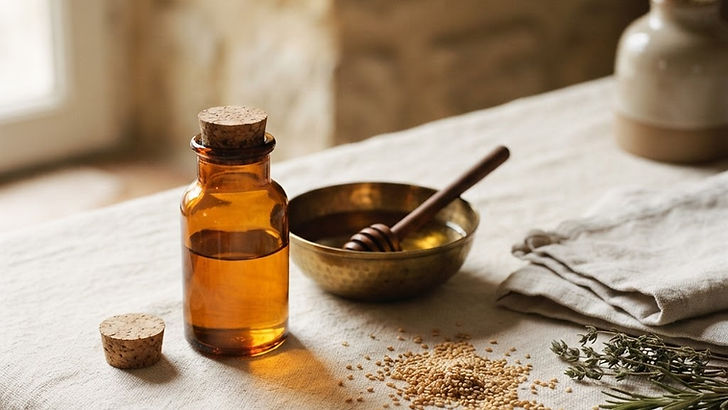
Warm oil, downward strokes, and a body that finally stops bracing. A working guide to abhyanga, to snehapana, and to the oils that make either of them worth doing.
There is a moment, about four minutes into a proper abhyanga, when the shoulders give up. The breath drops lower. The jaw unclenches without being asked. Nothing dramatic happens, and that is the point.
Ayurveda has been putting oil on bodies for at least two thousand years, and it has never treated this as pampering. Oil is a medicine, a daily discipline, and in some cases an entire treatment programme. This is how it actually works, which oils are used for what, and why the classics were so insistent that it happen daily rather than when you remember.
What abhyanga actually is
The word is abhi, toward or all around, and anga, limb. Whole-body oleation with warm oil, applied in a specific direction, at a specific temperature, for a specific length of time.
It is not a deep-tissue massage. The pressure is firm but never brutal, the strokes are long and rhythmic, and the direction matters more than the force. In a clinical setting abhyanga is a purvakarma, one of the preparatory actions that soften the body before deeper work. At home it is something simpler and more useful: ten minutes that change the quality of the day.
The details that decide whether it works
Warm the oil, never overheat it. A bottle standing in a mug of hot water for five minutes is enough, and oil that stings is oil that has been ruined.
Stroke downward on the limbs, away from the heart, following the direction of the hair. Work joints in circles, the abdomen clockwise, the soles and scalp generously. Leave the oil on for ten to fifteen minutes before a warm shower, using soap only where you actually need it.
Skip the cold plunge afterwards, and skip the gym for an hour. The point is to keep the warmth in.
Snehana, the wider word
Snehana means oleation: making something unctuous, slippery, nourished. Abhyanga is one form of it. There are many.
Externally, snehana includes the oil massage itself, potli massage with warm herbal bundles, shirodhara, kati basti over the lower back, netra tarpana for the eyes, and nasya, oil dropped into the nostrils. Internally, it is snehapana: medicated ghee or oil taken by mouth in measured, increasing doses.
Both aim at the same thing. Oleation loosens what has become stuck, moves vitiated dosha and accumulated ama out of the tissues and back toward the gut, where it can be expelled. This is why snehana comes first in the classical sequence of snehana, svedana, shodhana: soften, then heat, then clear.
Snehapana: drinking the oil
This is the part people find astonishing. In a supervised programme, ghee or medicated oil is drunk at dawn on an empty stomach, in a dose that increases over three to seven days, with warm water sipped in between and no food until the oil has moved.
The practitioner watches for the signs of proper oleation: skin that feels soft and slightly oily, a lighter body, a settled appetite, a glossy coating in the stool. Then the cleanse itself follows, usually virechana or basti.
It is powerful, and it is not a home experiment. The dose is calculated from your digestion, your constitution and your current state, and the wrong dose at the wrong time makes a person miserable. If you want to understand the experience without guessing, snehana therapy is the supervised way in, and a four day kitchari cleanse is the gentler entry point most people should start with.
Why oil belongs in dinacharya
Dinacharya is the order of the day, the sequence Ayurveda recommends from waking to sleeping. Abhyanga sits inside it, not as a treat but as maintenance, alongside scraping the tongue and drinking warm water.
The classical benefits list is longer than most people expect. It relieves fatigue, slows the wear of ageing, settles vata, sharpens the senses, strengthens the skin, supports sleep, and gives the body a certain resilience that is hard to name and easy to feel. Charaka's chapter on the daily regimen treats oiling as ordinary, which is exactly what it should be.
Translated into the body you actually live in, it comes down to six things.
- The nervous system. Slow, warm, predictable touch is one of the fastest routes out of sympathetic overdrive. Ten minutes of it does more for a wired evening than another hour of scrolling.
- Sleep. Vata governs the nervous system and the night. Dry, cold, mobile vata is what wakes people at three in the morning, and warm oil on the soles and scalp is the oldest remedy for it, and still one of the best.
- The skin. Oil does not simply sit on the surface. It softens the outer layer, reduces water loss, and calms the low-grade inflammation that shows up as tightness, flaking and reactivity.
- Joints and fascia. Connective tissue that is hydrated and warm moves differently from tissue that is dry and guarded. Most stiffness is not damage, it is bracing, and oil plus touch gives the body permission to stop.
- Circulation and lymph. Long strokes toward the heart move fluid that has pooled. It is not a detox in the marketing sense, it is drainage, and it helps.
- Attention. You cannot oil a leg while answering email. The practice quietly returns you to your own body once a day, which is a medicine of its own.
Daily, small and unremarkable beats weekly and heroic. That is the whole argument for dinacharya.
Ritucharya: the same oil is not right all year
Ritucharya is the seasonal counterpart, and it is where most oiling advice online falls apart. Oil is not one substance with one effect. Sesame is warming and penetrating, coconut is cooling and light. Using the right oil in the wrong season is how people end up with breakouts in June or a cold they cannot shake in January.
The classical year runs in three movements, and Hong Kong compresses all of them.
- Cool and dry, roughly November to February. Vata season. Sesame oil, warmed generously, longer retention, hot baths, and more oil rather than less.
- Damp and heavy, roughly February to April. Kapha season. A lighter touch, less oil, more dry brushing and movement, mustard oil used sparingly for cold congestion, and no long oily lie-ins.
- Hot and humid, roughly May to September. Pitta season. Coconut or ksheerabala, cool rather than warm, shorter retention, and a break from heavy oil on the scalp if you run hot.
If your skin tells a different story to the calendar, believe your skin and adjust. Our seasonal guide walks through the Hong Kong version month by month, and the dosha quiz is a reasonable starting point if you genuinely do not know which way your body leans.
The oils, and who each one is for
This is the part worth reading twice. The oil is the treatment, and the wrong one is worse than none.

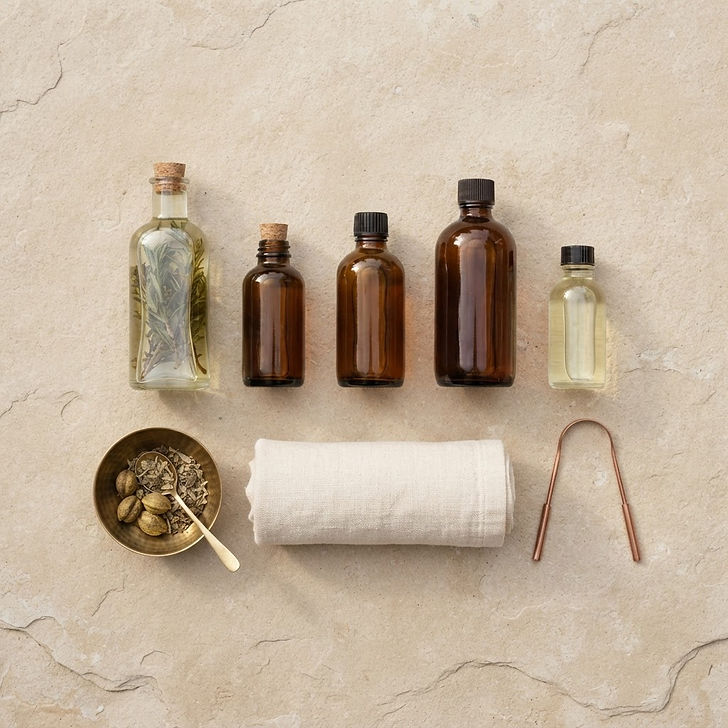
- Sesame oil is the default base for a reason: warming, penetrating, deeply vata-pacifying. Cold hands, cracked heels, stiff mornings, restless sleep, dry skin. If you own one oil, own a medicated sesame base like Dhanvantaram tailam.
- Coconut oil is the pitta answer: cooling, light, calming to heat, rash, sunburn and a hot temper. Excellent in summer, and on the scalp for people who overheat.
- Mustard oil is heating and sharp, traditionally used in winter for cold, damp congestion and for the feet before bed. Dilute it, and never use it on inflamed skin.
- Castor oil is a medicine more than a massage oil, sticky and deep, used for stubborn constipation and localised pain. We wrote about it properly in our castor oil guide.
- Dhanwantharam tailam is the classical restorative: postnatal recovery, weakness, nerve pain, stiffness that has settled in. Warming and grounding. The Kottakkal version is what we stock, and Chikkapatham is its lighter sibling, easier for daily use, for children, and for bodies that find the full strength too heavy.
- Ksheerabala 101 Avarthi is bala processed a hundred times in milk. Cooling, deeply nourishing to the nervous system, and the oil I reach for with insomnia, anxiety, headaches and burnout. Our 10 ml bottle lasts months, because a few drops on the scalp and soles at night is enough.
- Anu tailam is for nasya, not for the body: two drops in each nostril in the morning for the head, neck, sinuses and mental fog. We keep Amrita Anu Tailam on the shelf.
- Ayurvedic facial oil is formulated for the face, which is thinner and more reactive than the body. Do not simply use body oil above the jawline if you are acne-prone. Ours is light enough for daily use.
Ten minutes, once a day
- Warm the bottle in a mug of hot water while you undress and lay a towel down.
- Start at the soles, then the scalp. These two places carry the most nerve endings and give the most back.
- Work the limbs in long downward strokes, then circles at the joints.
- Oil the abdomen clockwise, in widening circles, following the direction of the colon.
- Oil the chest and back with upward strokes toward the heart.
- Sit for ten to fifteen minutes. Breathe. Do not start the day's admin.
- Shower warm, not hot, with soap only where needed, and pat dry rather than scrub.
- Repeat tomorrow, imperfectly. A five-minute version done daily outperforms a perfect one done monthly.
Tools help more than people expect. A potli bundle for warmth on stiff shoulders, a head stimulator for the scalp, and the Daily Ritual Bundle if you would rather start with one considered set than build one yourself.
When not to oil
Oil is not neutral, and there are days to skip it.
Skip abhyanga during a fever or any acute illness, when the tongue is heavily coated and the body feels heavy, during acute indigestion or diarrhoea, over infected or broken skin, on a fresh injury or a hot swollen joint, and immediately after a heavy meal.
In pregnancy, keep the abdomen and lower back light and let a practitioner guide you. During heavy menstrual bleeding, oiling the lower body is generally paused. If you are managing a chronic condition, the safe answer is a conversation, not a blog post.
When ten minutes is not enough
Home oiling maintains. It does not resolve everything, and there are states of the body that need the full clinical version: oil applied by trained hands, in the right quantity, with heat, over consecutive days.
Abhyanga, the flowing meditation is the full treatment, and the closest thing to understanding the practice properly. Snehana therapy works deeper on the joints and nervous system. Potli massage brings heat into stiffness that oil alone will not shift. Naval oiling is a quieter, shorter session for the gut and the mind.
If you are not sure which, book a consultation and we will work it out from your history rather than from a symptom list.
The short version
Oil your body most days, with the oil that suits your constitution and the season. Warm it, stroke downward, leave it a few minutes, wash it off. Drink oil only under supervision, because that is a different medicine with a different set of rules.
Everything else is detail. Useful detail, but detail.
Know someone who needs this? Send it on.
WhatsAppThe journal, by letter
Slow notes, once a month.
Seasonal eating, new recipes and the rituals worth keeping — written by Lakshmi and sent from her own inbox.
Work with Lakshmi
If this raised a question about your own health, a consultation is the place to take it.
Ayurveda works alongside, not instead of, your medical care. I do not diagnose disease or replace your doctor.


